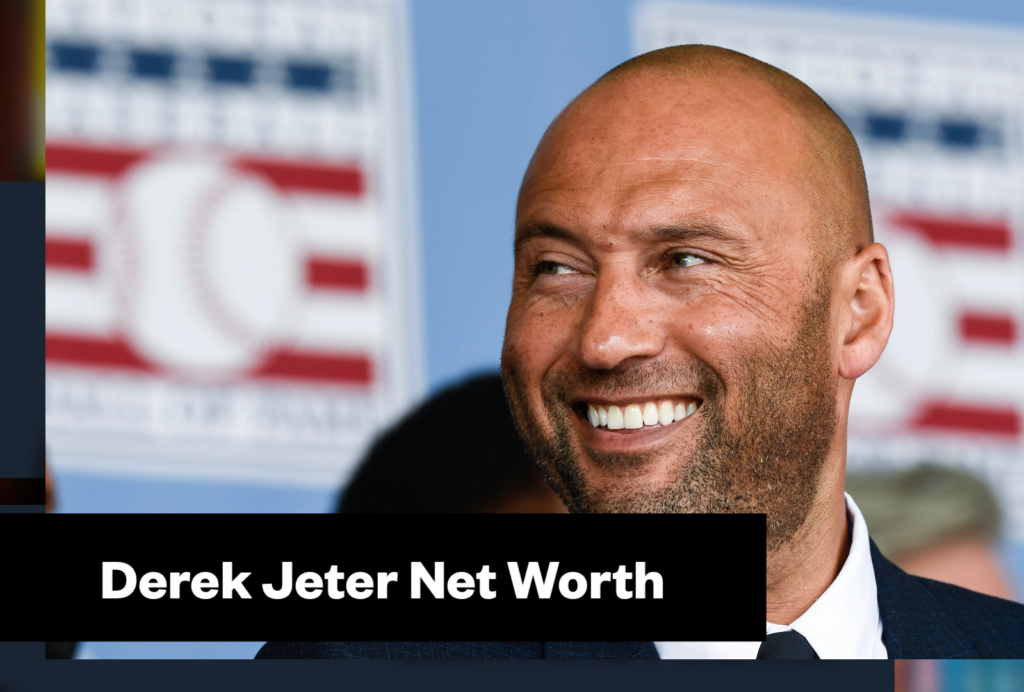
Derek Jeter’s estimated net worth, MLB salary, career earnings, endorsements, business ventures, Marlins ownership and financial legacy explained.
Key Highlights
- Derek Jeter is a former New York Yankees shortstop and one of the most successful baseball players of his generation.
- His net worth is widely estimated in the hundreds of millions, supported by verified MLB salary earnings, endorsements and business ventures.
- He earned about $265 million to $266 million in MLB salary during his playing career.
- Jeter made major endorsement income from brands such as Nike, Gatorade, Movado, Rawlings and other companies.
- He later became part of the Miami Marlins ownership group and served as the team’s CEO.
- His financial success is built on elite performance, brand value, long-term reputation and post-retirement business moves.
Introduction
Derek Jeter is one of the most recognisable names in baseball history. Best known for his 20-year career with the New York Yankees, he became a symbol of consistency, leadership and championship success. His calm personality, clutch performances and clean public image helped him become one of the most marketable athletes in American sport.
Interest in Derek Jeter’s net worth is strong because his financial journey goes far beyond baseball salary. During his playing career, he earned hundreds of millions of dollars from MLB contracts. Off the field, he built one of the strongest endorsement profiles in baseball, working with major brands and maintaining a reputation that made him valuable to advertisers.
After retirement, Jeter moved into business and sports ownership. His role with the Miami Marlins added another layer to his financial profile, showing how elite athletes can transition from players into executives, investors and brand owners.
Unlike weaker net worth topics, Derek Jeter’s wealth can be discussed with real financial substance. His salary history is documented, his endorsement profile was widely reported, and his business moves are part of the public record. While his exact personal net worth still depends on private assets, taxes, investments and spending, his career earnings and financial path are clear enough for a strong, useful profile.
Quick Profile Table
| Detail | Information |
|---|---|
| Full Name | Derek Sanderson Jeter |
| Profession | Former professional baseball player, executive and businessman |
| Nationality | American |
| Date of Birth | 26 June 1974 |
| Birthplace | Pequannock Township, New Jersey, United States |
| Known For | New York Yankees captain and Hall of Fame shortstop |
| MLB Team | New York Yankees |
| Playing Career | 1995 to 2014 |
| Estimated Net Worth | Commonly estimated in the hundreds of millions |
| Verified MLB Salary Earnings | About $265 million to $266 million |
| Main Income Sources | MLB salary, endorsements, business ventures, investments and sports ownership |
| Major Achievement | Five-time World Series champion |
| Hall of Fame | Inducted into the National Baseball Hall of Fame |
Derek Jeter Estimated Net Worth
Derek Jeter’s exact net worth is not confirmed through public personal financial records, but he is widely estimated to be worth hundreds of millions of dollars. Unlike many celebrity wealth topics, Jeter’s financial profile has strong evidence behind it because his baseball salary earnings are well documented.
Baseball-Reference lists his career salary total at about $265.16 million, while Spotrac lists his MLB career earnings at about $266.26 million. These figures only cover salary from his playing career and do not include endorsement deals, investments, business income, media ventures or any returns from his Miami Marlins ownership period.
This means Jeter’s total career earnings were likely much higher than his MLB salary alone. Forbes reported during his playing career that he was baseball’s top pitchman, with endorsement deals linked to Nike, Gatorade, Steiner Sports, Movado, Rawlings, 24 Hour Fitness and Avon Products. Forbes also reported in 2015 that Jeter made an estimated $130 million from endorsements over his career.
However, career earnings and net worth are not the same thing. Jeter’s net worth would be affected by taxes, agent fees, business expenses, investments, property holdings, charitable giving and personal financial decisions. Still, his documented salary and endorsement income make him one of the strongest athlete wealth profiles in baseball.
MLB Salary and Contract Earnings
Derek Jeter’s MLB salary was the foundation of his financial success. He played his entire 20-year career with the New York Yankees, one of the most valuable and visible franchises in global sport.
Jeter’s largest contract was the 10-year, $189 million deal he signed with the Yankees in 2001. That contract placed him among the highest-paid players of his era and reflected his value as both an elite shortstop and the face of the franchise.
His later contracts continued to add to his career earnings. In 2014, his final season, Forbes reported that he signed a one-year deal worth $12 million before retiring at the end of the season.
By the end of his playing career, Jeter had earned more than $265 million in MLB salary. That is before considering endorsements and business income.
This matters because baseball contracts are usually more predictable than some other athlete income sources. A guaranteed MLB contract can provide major financial security, especially when a player stays healthy and productive for many years.
Jeter’s salary history shows the value of elite performance combined with long-term franchise loyalty. He was not just a star player. He was the captain and public face of the Yankees, which made his value even greater.
Endorsements and Brand Deals
Endorsements were one of the biggest reasons Derek Jeter’s financial profile became larger than salary alone. He was marketable because he combined performance, fame, discipline and a low-scandal public image.
Forbes described him as baseball’s top pitchman during his final playing season. His endorsement partners included Nike, Gatorade, Movado, Rawlings, Steiner Sports, 24 Hour Fitness and Avon Products.
In 2005, Forbes reported that Jeter had a league-high $6 million in annual endorsement income. Later, Forbes estimated that he made more endorsement money than any other player in baseball history, with about $130 million from endorsements.
This is important because baseball players often earn less from endorsements than basketball, football or global football stars. Baseball is a major sport in the United States, but its athletes do not always become global marketing icons. Jeter was an exception.
His brand worked because he represented reliability, professionalism and winning. Companies could associate him with leadership, class and success without taking on the risk that sometimes comes with more controversial celebrity figures.
That brand value helped him earn well during and after his playing career.
Career Journey: From Yankees Prospect to Baseball Icon
Derek Jeter was drafted by the New York Yankees in the first round of the 1992 MLB Draft. He made his MLB debut in 1995 and became the Yankees’ starting shortstop in 1996.
His timing was perfect. The Yankees were entering one of the most successful periods in franchise history, and Jeter quickly became central to that dynasty. In 1996, he won the American League Rookie of the Year award and helped the Yankees win the World Series.
Over the next several years, Jeter became a key part of a team that won championships in 1996, 1998, 1999, 2000 and 2009. His career was defined by postseason success, consistency and leadership.
He finished his career with 3,465 hits, 260 home runs, a .310 batting average and 14 All-Star selections. Baseball-Reference lists his career wins above replacement at 71.3, showing his long-term value as a player.
Jeter was also known for memorable postseason moments. His calm style and ability to perform under pressure strengthened his image as one of baseball’s most dependable stars.
In 2014, he retired after spending his entire career with one team. That loyalty became part of his brand and helped preserve his legacy.
Why Jeter’s Yankees Brand Was So Valuable
Derek Jeter’s financial success cannot be separated from the New York Yankees brand. The Yankees are one of the most famous sports teams in the world, and Jeter became the face of the franchise during a period of major success.
Playing in New York gave him a larger media platform than many athletes in smaller markets. Every big performance, playoff moment and endorsement campaign reached a large audience.
The Yankees’ global fan base also increased his commercial value. A player who succeeds in New York can become more than an athlete. He can become a cultural figure.
Jeter’s public image matched the Yankees’ traditional brand: professional, polished, successful and historic. That made him valuable not only to the team, but also to advertisers and business partners.
His financial story shows that athlete wealth is not just about statistics. Market, image, timing, team success and public trust all matter.
Miami Marlins Ownership and CEO Role
After retiring from baseball, Derek Jeter moved into sports ownership and executive leadership. He joined the Bruce Sherman-led ownership group that purchased the Miami Marlins for $1.2 billion in 2017.
Jeter served as CEO and reportedly held a 4 percent stake in the franchise. MLB reported that he oversaw day-to-day operations before he and the Marlins parted ways in February 2022. ESPN also reported that Jeter gave up his 4 percent stake when he left the organisation.
This period was important for his post-playing financial profile. Even though his Marlins tenure had mixed results on the field, it showed his interest in team ownership, executive decision-making and long-term sports business.
The Marlins role also showed that Jeter was trying to move beyond being a retired athlete. He wanted to operate inside the business side of baseball.
Front Office Sports estimated in 2022 that his 4 percent stake was worth roughly $44.8 million, although the actual financial terms of his exit were not fully public. That figure gives a sense of how valuable even a minority ownership stake in a major sports franchise can be.
Business Ventures and Media Interests
Derek Jeter has also been involved in media and business projects. One of his most recognised ventures was The Players’ Tribune, a digital media platform created to allow athletes to tell their own stories directly.
The Players’ Tribune strengthened Jeter’s image as more than a former athlete. It positioned him as someone interested in athlete branding, media ownership and content distribution.
This type of business move makes sense for a player like Jeter. His career was built on reputation and trust, so a media platform centred on athlete voices fitted his brand.
Beyond media, Jeter’s business value comes from his name. His identity is connected to leadership, winning and professionalism. That kind of reputation can support speaking opportunities, brand partnerships, executive roles and investment opportunities.
Net Worth vs Career Earnings
Derek Jeter’s net worth should not be confused with his total career earnings.
His MLB salary alone was about $265 million to $266 million. Endorsements may have added roughly $130 million over his career, based on Forbes estimates. Combined, that suggests his pre-tax career earnings were far higher than his baseball salary total.
But net worth is what remains after many factors are considered. These include:
- federal and state taxes
- agent and management fees
- lifestyle expenses
- investments
- real estate
- business gains or losses
- charitable giving
- family and estate planning
- asset appreciation or depreciation
This is why two athletes with similar career earnings may have very different net worth figures. The final number depends on how money is managed, invested and preserved.
Jeter’s advantage is that his earning power continued after retirement. His reputation allowed him to enter media, ownership and business opportunities that many retired athletes do not access.
Derek Jeter Compared With Other Baseball Stars
Derek Jeter is one of the highest-earning baseball players in history, but his financial profile is different from newer MLB stars who signed larger contracts after salaries increased across the league.
Modern players such as Shohei Ohtani, Mike Trout and others have benefited from the growth of sports revenue and larger contracts. Jeter played in an earlier salary era but still earned more than $265 million from MLB contracts.
His endorsement value is where he stands out. Forbes reported that he made more endorsement income than any other player in baseball history at the time of its 2015 report. That is a major distinction because baseball endorsement income is usually not as high as in some other sports.
Compared with Alex Rodriguez, another Yankees star, Jeter’s brand was built more on trust, consistency and leadership. Compared with many retired players, he also had a stronger post-career business pathway through the Marlins and media ventures.
His financial legacy is therefore a mix of salary, brand value, business ambition and long-term reputation.
Assets, Lifestyle and Public Image
Derek Jeter has long been associated with a polished and private lifestyle. He became famous in one of the most media-heavy cities in the world, yet he maintained a public image that was generally controlled and professional.
His lifestyle has included high-value real estate and luxury living, but his public brand has never depended mainly on showing off wealth. Instead, he is known for discipline, privacy, family life, business moves and baseball legacy.
This matters because a clean public image helped protect his endorsement value. Many brands prefer athletes who bring trust and stability. Jeter’s image made him commercially attractive for many years.
His Turn 2 Foundation, launched in 1996, also added to his public reputation. The foundation focuses on helping young people avoid harmful behaviour and develop leadership, healthy choices and academic success. This philanthropic work supported his image as a role model beyond baseball.
Factors That May Affect Derek Jeter’s Net Worth
Several factors can affect Derek Jeter’s net worth over time.
Investment Performance
Jeter’s wealth after retirement depends partly on how his money is invested. Business ventures, real estate and private investments can increase or reduce net worth.
Brand Partnerships
Even after retirement, Jeter’s name remains valuable. New endorsements, appearances and partnerships can continue to generate income.
Sports Business Opportunities
Jeter’s Marlins role showed his interest in team ownership. Future sports business opportunities could affect his financial profile.
Media Ventures
Athlete-driven media, storytelling and sports content remain valuable industries. Jeter’s connection to The Players’ Tribune shows his interest in this space.
Real Estate and Assets
Property values can affect net worth, especially for wealthy individuals with major real estate holdings.
Taxes and Lifestyle Costs
Taxes, estate planning, personal expenses and charitable commitments can also affect long-term wealth.
Financial Lessons From Derek Jeter’s Career
Derek Jeter’s career offers several useful financial lessons.
First, reputation can be a financial asset. Jeter’s clean image helped him earn endorsement money that many baseball players never reach.
Second, consistency creates value. He played 20 seasons for one team and built trust with fans, sponsors and the Yankees organisation.
Third, a strong market can increase earning power. Playing in New York helped Jeter become more visible and commercially valuable.
Fourth, athletes can build wealth beyond salary. Jeter used his name and reputation to enter endorsements, media and sports ownership.
Finally, legacy matters. A Hall of Fame career, championships and public trust can continue creating opportunities long after retirement.
Conclusion
Derek Jeter’s net worth is supported by one of the strongest financial profiles in baseball. His MLB salary earnings alone reached about $265 million to $266 million, while endorsements added major income throughout his career. Forbes reported that he was baseball’s top pitchman and estimated that his endorsement earnings reached about $130 million.
His wealth was not built from salary alone. It came from performance, championships, marketability, business moves, media ventures and sports ownership. His time with the Miami Marlins showed his interest in the executive side of baseball, while his brand remains one of the most respected in American sport.
Derek Jeter’s financial journey is a strong example of how an athlete can turn elite performance into long-term wealth, business credibility and public trust.
FAQs
What is Derek Jeter’s net worth?
Derek Jeter’s exact net worth is private, but he is widely estimated to be worth hundreds of millions of dollars. His verified MLB salary earnings alone were about $265 million to $266 million.
How much did Derek Jeter earn in MLB salary?
Derek Jeter earned about $265 million to $266 million in MLB salary during his 20-year career with the New York Yankees.
How did Derek Jeter make his money?
He made money through MLB contracts, endorsements, business ventures, media projects, investments and his former Miami Marlins ownership role.
What brands endorsed Derek Jeter?
Forbes reported that Jeter had endorsement deals with brands including Nike, Gatorade, Movado, Rawlings, Steiner Sports, 24 Hour Fitness and Avon Products.
Did Derek Jeter own part of the Miami Marlins?
Yes. Derek Jeter was part of the Miami Marlins ownership group and reportedly held a 4 percent stake while serving as CEO. He gave up that stake when he left the organisation in 2022.